
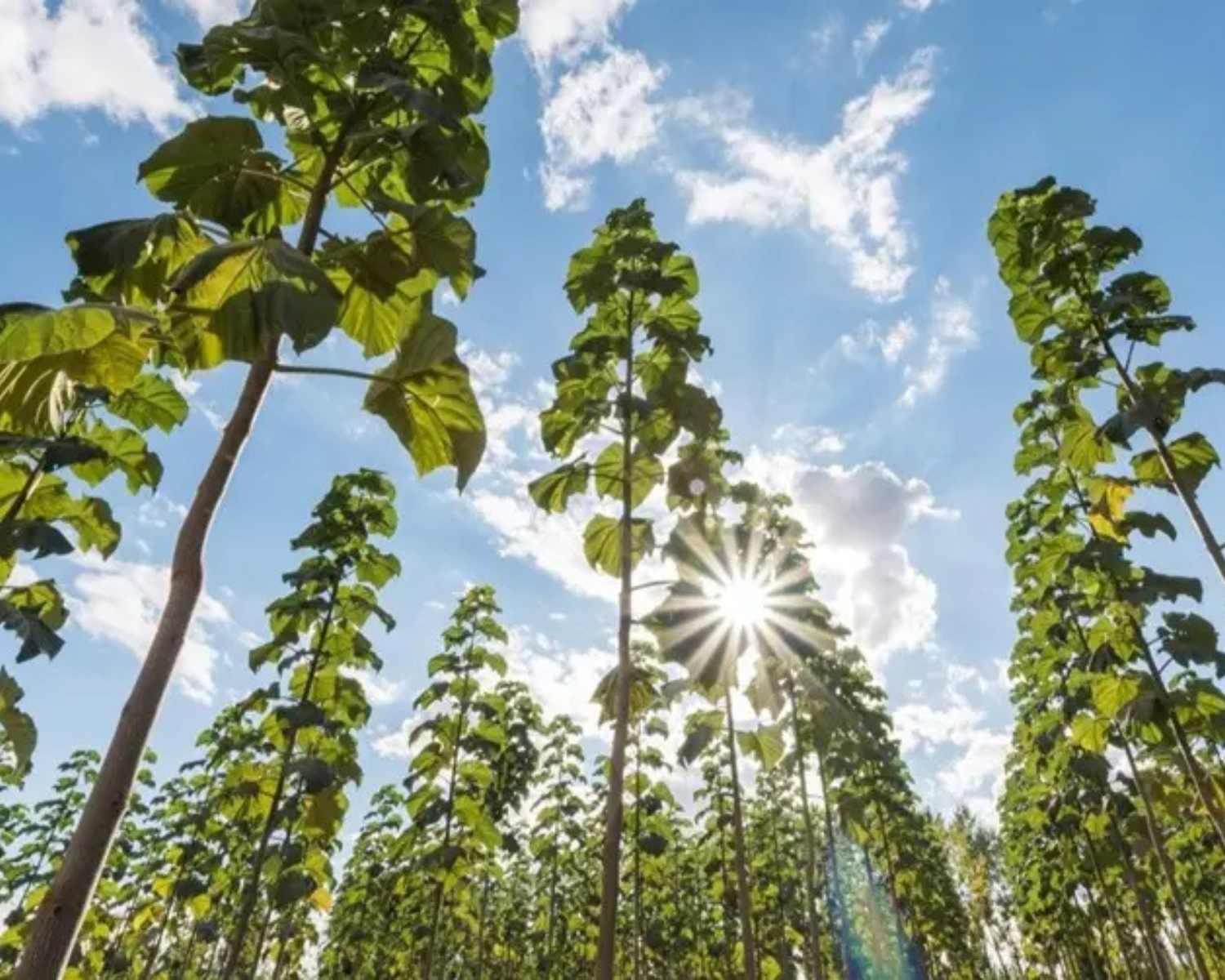
Some trees take a human lifetime to mature — the Kiri tree does not. With exceptionally fast growth, high CO₂ capture, and genuinely versatile timber, it combines ecological impact with economic substance. That's exactly why Kiri trees, also known as Kiri Paulownia, sit at the heart of the FutureTree approach: a real, sustainable tree investment with measurable impact.
Buying a Kiri tree means investing not just in reforestation, but in a long-term asset. Here's what makes this species remarkable — and why choosing the right variety is decisive.
Kiri Trees: Growth That's Hard to Believe
Most hardwoods are patient. Oak, beech, and spruce measure their lives in decades — often 40 to 120 years before they're ready to harvest. The Kiri tree thinks on a completely different timescale.
Under good conditions, a young Paulownia can put on several metres of height in a single growing season, reaching a harvestable stem in just a handful of years. FutureTree plantations work on short rotation cycles of roughly 7–10 years — compared with the half-century or more demanded by conventional European hardwoods.
And here's the part most people don't expect: when a Kiri tree is harvested, it doesn't die. It re-sprouts from its own stump, so a single planting can be harvested again and again without replanting. Each cycle pulls a fresh dose of carbon out of the air and produces a new volume of usable wood.
CO₂ Capture, Not Just Offsetting
Fast growth is the decisive point when it comes to climate. A tree captures carbon in direct proportion to how much wood it builds — because roughly 47% of dry wood is carbon. Build wood quickly, and you capture carbon quickly.
Peer-reviewed field studies place Paulownia among the high-performing sequestration species:
- Mature stands store on the order of 9 tonnes of carbon per hectare per year
- An average capture potential of around 1.78 tonnes of CO₂ per tonne of biomass each year
- The carbon stays locked in long-life timber products for a minimum of 40 years
Unlike conventional voluntary offsetting, the impact at FutureTree is based on real biological growth. That gives a solid foundation for companies that want to buy CO₂ certificates or set up their carbon offsetting strategically.
Featherlight Kiri Wood With Economic Yield
Alongside its ecological impact, the economic perspective matters. At around 270–350 kg/m³, Kiri wood is one of the lightest temperate hardwoods in the world — roughly a third the weight of oak. That low weight comes with a surprisingly useful set of properties:
- Naturally insulating — low density, low thermal conductivity
- Favourable fire behaviour — it chars rather than flaring up
- Dimensionally stable — it stays put indoors
- Easy to work — quick to cut, shape, and dry
Kiri wood is light, stable, and highly versatile, which makes it increasingly attractive in the international timber trade. The timber yield adds a second value layer to the climate impact and makes the investment plannable for the long term — a sustainable timber investment that doesn't depend on short-term market swings, but on real demand and clear growth cycles.
The Variety Matters: Non-Invasive Cultivation
Here FutureTree is deliberately transparent, because the Kiri tree comes with one important caveat.
The wild ornamental species Paulownia tomentosa produces huge quantities of windblown seed and can spread on its own. For that reason it has been classified as invasive in several places — Switzerland, for example, listed it as an invasive alien species in March 2024 and banned its sale and cultivation from that September.
So let's be clear: FutureTree does not plant the wild species. Our plantation stock comes exclusively from registered, EU plant-variety-protected hybrids developed for sustainable timber production:
- H2F3® and H2F4® — contain no P. tomentosa genetics; confirmed non-invasive
- Phoenix One® — a sterile hybrid
- NordMax21® — grown across ~30 plantations in Germany for 13+ years with no independent spread ever observed
This is backed by strict site selection: land is excluded if it is forest (or was since 1989), if it is wetland or peatland, or if it needs flood irrigation. Wherever possible, we plant on fallow land unused for 15+ years — so our trees never compete with food production.
Tree Investment for Businesses and Individuals
FutureTree offers structured tree investment solutions for businesses as well as tree investments for individuals. Whether as part of a corporate ESG strategy or as a personal form of carbon offsetting — the approach stays the same: real trees, transparent impact, and a long-term perspective. Digital tree tracking means you can always see where the trees stand, how they grow, and what they contribute.
Let's discuss the right solution for your tree investment
Whether you want to invest in Kiri trees and CO₂ certificates or are looking for a long-term solution for your carbon offsetting — we'll help you build a sustainable strategy with substance.
👉 Book a personal call now and let's discuss how a Kiri tree investment fits your specific goals.
Share this article